Recipes › Dessert › Friuli-Venezia Giulia
Automatically translated from Italian · Show original
Gubana
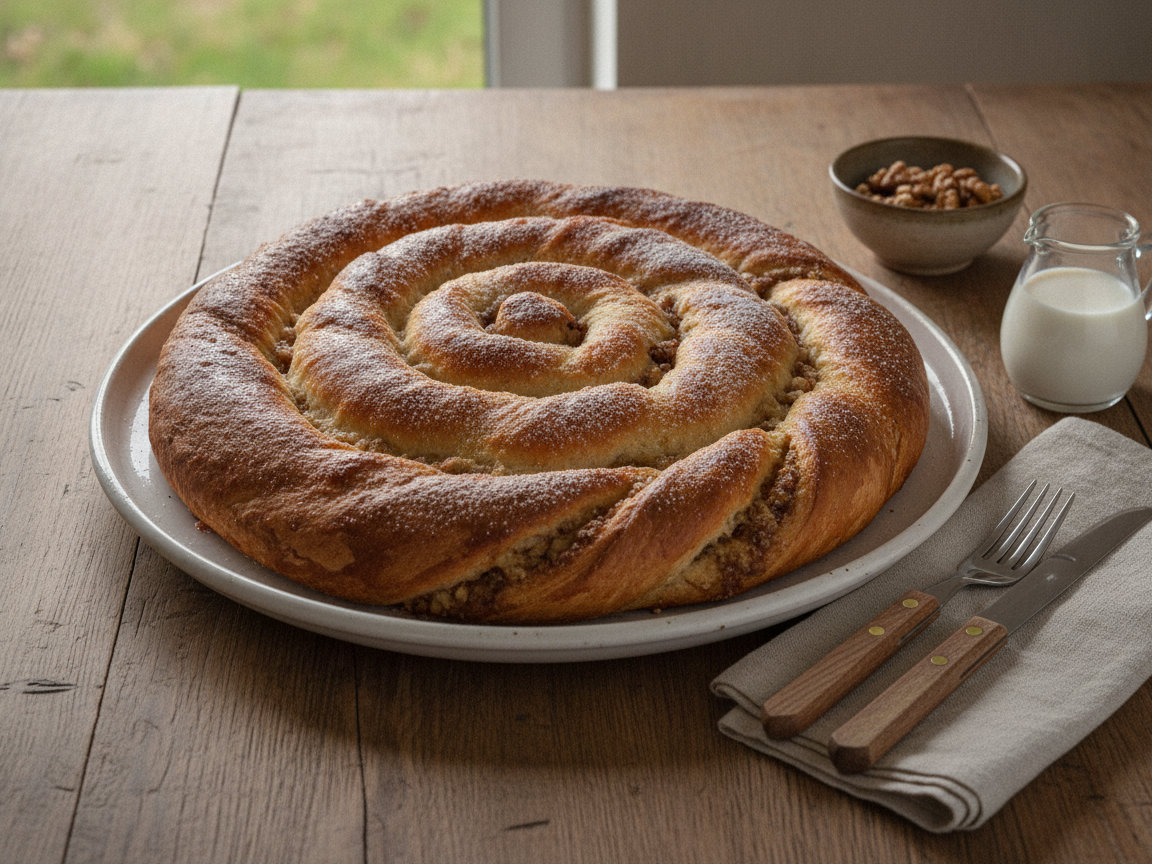
The snail-shaped leavened dough from the Natisone Valleys filled with walnuts, raisins, pine nuts, cocoa, and grappa.
by Editorial team
- Servings
- 12
- Prep
- 1 h
- Cook
- 50 min
- Total (incl. proving)
- 4 h 50 min
Tools: Forno · optional: Planetaria
Method
- 120 min
Careful: Add the butter only when the dough has already gained consistency, otherwise it will struggle to develop.
Dissolve 15 g of brewer's yeast in 120 ml of lukewarm milk. In a large bowl, pour 400 g of 00 flour, add the milk with the yeast, 2 eggs, 100 g of sugar, and the grated zest of 1 lemon. Work by hand or in a stand mixer with the hook at medium speed for about 10 minutes, then incorporate 120 g of soft butter a little at a time, continuing to knead for another 10 minutes.What it should look like: Smooth, elastic, and well-developed dough.
- 2
Careful: Cover with plastic wrap or a damp kitchen towel, otherwise the dough will form a crust on the surface.
Form the dough into a ball, place it in a lightly greased bowl, cover well, and let it rise in a warm place away from drafts (an oven turned off with the light on is ideal).What it should look like: Dough doubled in volume, soft and puffy.
Proving: 2 h
- 3Soak 120 g of raisins in 40 ml of grappa. In a bowl, combine 200 g of chopped walnuts, the raisins with their grappa, 50 g of pine nuts, 15 g of unsweetened cocoa powder, 60 g of crumbled dry biscuits, and the remaining 50 g of sugar, then mix well until you obtain a homogeneous filling.10 min
What it should look like: Moist, well-distributed, and aromatic filling.
- 4Turn the risen dough out onto a lightly floured work surface and roll it out with a rolling pin to form a rectangle of about 40x30 cm and about half a centimeter thick. Distribute the filling evenly over the entire surface, leaving a 2 cm border free along the sides.10 min
What it should look like: Regular rectangle with the filling distributed evenly.
- 510 min
Careful: Carefully seal the edges and ends of the roll to prevent the filling from leaking out during baking.
Roll up the dough from the long side to form a tight cylinder and seal the ends well. Grease a 24-26 cm diameter round springform pan and place the roll inside, wrapping it on itself in a snail shape, starting from the center outwards.What it should look like: Compact spiral-rolled cylinder inside the pan.
- 6
Careful: Cover with a light cloth or loose plastic wrap so as not to crush the surface of the rising cake.
Cover the pan and let it rise again in a warm place for 1 hour, until the Gubana has visibly swollen, filling the spaces of the pan well.What it should look like: Gubana swollen and ready for baking.
Proving: 1 h
- 7Preheat the oven to 170 °C in static mode. Beat the 1 remaining egg in a small bowl and gently brush the entire surface of the Gubana.5 min
What it should look like: Shiny surface covered evenly with a thin layer of egg.
- 850 min
Careful: Do not open the oven in the first 30 minutes of baking so as not to compromise the rising of the cake.
Place on the middle rack and bake in a static oven at 170 °C for about 50 minutes, until the surface is a uniform golden-brown color. Remove from the oven and let cool completely in the pan before unmolding.What it should look like: Well-baked cake, dry when tested with a toothpick, and uniformly golden.